

Thank you for supporting our "Buy One Give One" project, which aims to deliver the same number of CARRY THE SUN lanterns purchased to people in need of light!
Before the COVID-19 pandemic, we personally delivered Carry the Sun lanterns to areas abroad lacking electricity and experiencing inconvenient living conditions, as well as to disaster-stricken areas within Japan. The pandemic made international travel impossible, making overseas transportation extremely difficult. The global logistics disruption and the increase in crime due to poverty caused by COVID-19 resulted in an almost catastrophic situation for logistics, especially to developing countries and regions without adequate electrical infrastructure.
Amidst these challenges, a local Vietnamese company with whom we had connections offered their cooperation, enabling us to donate Carry the Sun lanterns to mountainous regions of Vietnam.
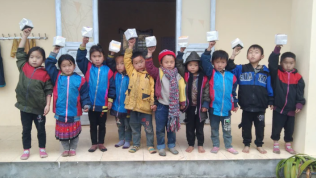
A total of 200 CARRY THE SUN lanterns were delivered to 8 ethnic minority boarding schools and elementary and junior high schools in the mountainous areas of Ha Giang Province in northern Vietnam and Thanh Hoa Province in central Vietnam.

Kashiwazaki (2022)
【Recipient Schools】
● 134 units to 6 schools in Ha Giang Province (Northern Vietnam)
1. Tung San Ethnic Minority Boarding School and Junior High School: 22 units
2. Dan Van Elementary and Junior High School: 23 units
3. Nam Khoa Ethnic Minority Boarding School: 45 units
4. Ban Peo Elementary and Junior High School: 2 units
5. Tan Tien Elementary School: 28 units
6. Nam Ty Elementary School: 14 units
● 66 units to 2 schools in Thanh Hoa Province (Central Vietnam)
1. Giao Thien Elementary School: 38 units
2. Dong Luong Kindergarten Elementary School: 28 units
This time, as part of a joint research project with Toyo University, we also conducted a survey on how the solar lanterns delivered to areas without electricity in Vietnam are being used. The survey was administered to a total of 131 students across 5 schools.
・Most children continue to use the lanterns primarily for studying.
・A habit of studying at home is emerging.
・New relationships and habits are forming, such as family members and school teachers cooperating to charge the lanterns outdoors.
・Some children lend them not only for their own use but also to family, relatives, and friends (especially in Ha Giang Province).
Kashiwazaki (2022)
Through the survey, it became clear that Carry the Sun is bringing about very meaningful changes in the lives of children living in mountainous areas without electricity. Previously, some students studied by hanging flashlights upside down from the ceiling at night, but Carry the Sun has made studying much easier.
Children living far from school have to leave home and go to school in the early morning (around 5 or 6 AM, when mountain roads are still dark) or return home when the sun has already set and mountain roads are dark (after 5:30 PM). Thanks to Carry the Sun, they can now commute to school more safely and securely.
Some students share the Carry the Sun with their families; their parents use it for farm work or pig farming, friends borrow it to visit their grandparents' houses, and grandmothers use it to thread needles when sewing clothes. Children are very happy with the lanterns, not just because they are bright, but also because they are beautiful and convenient.
■ GIAOTHIEN School
Hung Village, Giao Thien Town, Lang Chanh District, Thanh Hoa Province
Number of households: 114
Population: 508
95% Thai, the rest Muong, in addition to the Kinh ethnic group.
Languages: Vietnamese, Thai, Muong
Hung Village is isolated from other villages, has no electricity or transport roads, and the road to school is a very high-risk area for landslides.

■ Tan Tien Elementary School
Tan Tien Town, Hoang Su Phi District, Ha Giang Province
Number of households: 836
Population: 3,967
In addition to the Kinh ethnic group, seven minority groups live here: Tay, Hmong, Nung, Dao, La Chi, and Han.
Languages: Primarily Vietnamese, Tay, Hmong, Nung, Dao
The Nung people primarily live by agriculture and animal husbandry. Their crafts are very diverse, including forging, casting, weaving, woodworking, and textile production.
The Nung people typically live in relatively large and spacious stilt houses along hillsides, valleys, rivers, and streams.
A distinctive local custom is the Nung people's forest (nature) worship.

■ Thung Area Dong Luong Elementary School
Thung Village, Dong Luong Town, Lang Chanh District, Thanh Hoa Province
Number of households: 57
Population: 285
Primarily Muong, in addition to the Kinh ethnic group.
Languages: Vietnamese, Muong
The Muong people live in stilt houses and are clustered in settlements in hilly areas, near rivers and streams.
Their main livelihoods are farming in fields and alluvial plains along rivers and streams, and their primary occupation is agriculture.
The Muong people have a long history and culture, with rich and diverse folk songs and dances. The Muong language has no script and belongs to the Vietnamese language group. Located 12 kilometers from the town center, the roads are paved with concrete, but there is a high risk of landslides.

There are still many underprivileged children who have not received lanterns.
There are many children who are orphans, living with elderly grandparents, or in other difficult circumstances.
The school teachers also expressed their desire for lanterns to be donated to other children.
Delivering light to poor children living in mountainous areas without electricity is a very meaningful activity, and we intend to continue providing Carry the Sun lanterns so that they can live a little more safely and securely.


